Engadin Ski Marathon 2026: When Durability Wins the Day

I signed up for the Engadin Ski Marathon (this year 43.5 Km) as a coaching experiment in motivation and durability—giving myself a clear target so I’d ski more and protect some non‑negotiable me‑time. My training wasn’t a classic ski‑marathon plan, but it was consistent: strength, cross‑training, and lots of easy Z1 work that quietly built a durable engine. Paired with solid ski prep and a well‑planned fueling strategy, that durability carried me much farther than “perfect” fitness on paper—I crossed the line in 2:40:26, tired, happy, and more convinced than ever this is the kind of approach I want my athletes to trust too.
The Lead-Up: Imperfect Prep, Solid Foundation

If you’ve followed my durability series, you know I care less about chasing peak fitness and more about building bodies that can handle the load of the sport they love. For this race, that looked very un‑sexy: short run commutes with the stroller, strength sessions squeezed between work and parenting, and the occasional roller ski or ski day when life allowed.
Did I have the ideal ski‑specific block? No.
Did I have months of “doable, repeatable” training behind me? Yes—and that mattered.
In the months leading up to the race, I often felt scattered, like family life and work had pulled me so thin that my body wasn’t really “there” yet in the way I wanted. On race day, I realized it actually was—what I’ve been missing isn’t capacity, it’s dedicated time and quiet moments to really listen to it.
One non‑negotiable: don’t underfuel 43.5 km and turn it into a death march. And because the universe has a sense of humor, the week before, I went telemark skiing for the first time in years and relearned the hard way that thicker socks do not mix well with those boots—cue some of the worst blisters I’ve ever had.
Between family commitments, a bachelorette party on Friday, and a wedding on Saturday, my pre‑race life looked anything but “ideal racer mode.” But the actual race prep was on point: perfect ski setup, a reviewed and realistic fueling plan, and clear priorities. Not glamorous, but very effective.
Race Day: From “Just Finish” to 2:40
The emotions of being in that massive start field were incredible. I felt more like an excited beginner than a well‑prepared racer, but my mind was clear: no obsessing over pace. I gave myself a few simple rules—listen to my body, stick to the fuel plan, look good, have fun, cheer people on.

Listen to my body. This meant staying honest about effort instead of chasing the pace I thought I “should” ski. It can go both ways—this time, I assumed I should hold back and ski slower, but my body kept telling me I could comfortably go faster, so I trusted that instead of my expectations.
Stick to the fuel plan. I treated fueling like a non‑negotiable skill, not an optional extra. Every 20 minutes I took in carbs and fluids, even when I didn’t feel hungry or felt I hadn’t “earned” it yet, trusting the plan I’d built at home so my brain and muscles never had to guess where their energy was coming from.
Look good. For me, “looking good” meant skiing with intention: tall posture, clean weight transfer, relaxed upper body. Any time things started to feel messy or frantic, I took a breath and tried to make the next few strides technically better, knowing that good form is basically free speed and free efficiency. When you look good, you’re usually moving more proficiently and efficiently anyway.
Have fun. My internal checkpoint was simple: if I caught myself grinding instead of smiling, something had to change—pace, breathing, or attitude. I kept lifting my head, taking in the views and the beautiful chaos around me, and letting that energy drive me.
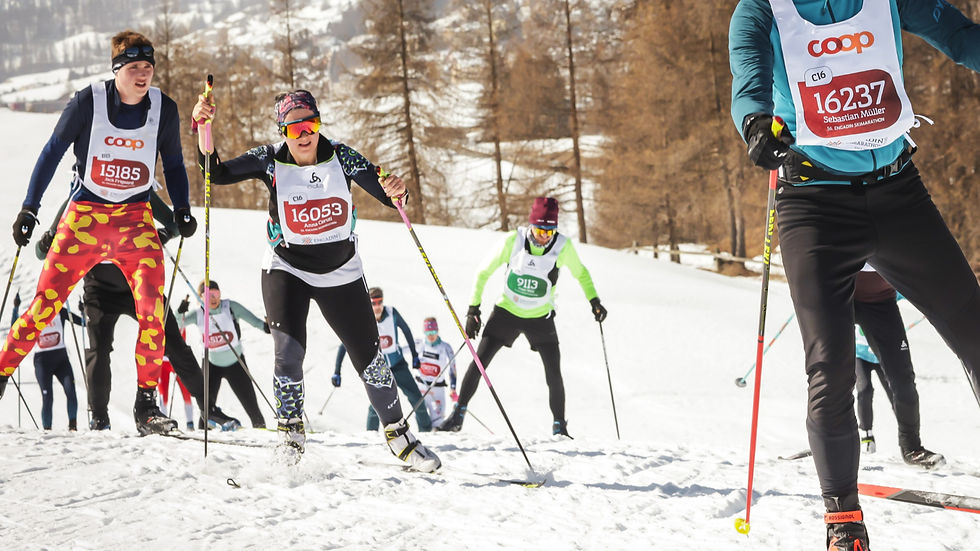
Cheer people on. I made it a point to be a positive presence on course: a quick “brava,” “bravo,” or “we’ve got this” for the skiers around me. Staying vocal and encouraging kept my own energy up, made the race feel like a shared adventure instead of an individual grind, and stopped me from disappearing into my own little bubble.
What Went Well (And Why It Matters)
Looking back, a few things clearly paid off:
Durability over peak fitness
I definitely wasn’t the fittest I’ve ever been, but my tissues were used to loading: feet, calves, hips, and back. Those short, consistent runs and strength sessions added up to resilience, and that’s why my body could handle 43.5 km without turning into a pain festival.
A simple, disciplined fueling plan
I didn’t do anything fancy. I picked products I knew, set a target of 70-80 g of carbs per hour, and committed to taking something every 20 minutes. The win wasn’t the exact grams; it was respecting the plan even when it would’ve been easier to skip a gel.
Dialed ski‑tech skills

Time away from regular team coaching and races hasn’t erased my inner ski nerd. I matched skis and structure to the forecast, enjoyed the ski prep, and showed up with skis that felt fast from the first to the last glide—making every stride a little easier and a lot more fun.
A solid race strategy
By studying the course and identifying the spots where I’d likely be forced to slow down—queues before climbs, narrow sections, gradual hills—I knew exactly where I could afford to push a bit and where I could “rest,” reset my technique, and fuel. That turned the natural flow of the race into a built‑in pacing and fueling plan instead of a series of frustrating bottlenecks.
Lessons I’m Bringing Back to My Athletes
Here’s where the coach in me gets excited. Engadin was fun, but it was also a live lab. These are the key takeaways I’ll be hammering home with my athletes:
You don’t need perfect training to have a good race.
You need consistent training that your life can actually support. If your plan is only doable on a perfect week, it’s not a good plan.
Durability is your insurance policy.
Strength work, smart progressions, and managing niggles early are what let you show up under‑trained and still perform without falling apart.
Fuel like performance matters, regardless of your race goal.
Underfueling turns an already long day into a miserable one. If you care enough to sign up and train, you care enough to fuel properly.
Race day is not the time to prove you’re tough.
It’s the time to execute the boring, simple habits you practiced: pacing, fueling, technique, and gear choices. Save the heroics for the final 10–20% if you actually have something left.
Stacking those five simple rules turned a potentially stressful race into a long, moving checklist of things I could actually control.
What This Race Reminded Me Of as a Coach and Mom
Beyond the stopwatch and the data, the Engadin Ski Marathon gave me something I really needed: a reminder of why I love this sport. Being surrounded by thousands of skiers in a stunning valley, hearing languages from all over, feeling the collective buzz of people who woke up early just to slide around on skinny skis—that’s the kind of energy you can’t replicate on a treadmill. And somewhere in the middle of all that movement and noise, I could feel my
body coming back to being my own again, not just a tool for getting through the day, but a place where I actually like spending time.
It also reminded me why I coach the way I do—and what I’m really aiming for with my athletes: to show up for big, meaningful goals, share the journey with others, cross the line tired but intact (with enough energy left for their families), and go home excited to keep playing the long game with their sport. If this race taught me anything, it’s that you can honor your current life season, train imperfectly, and still create a day you’re proud of—if you respect durability and execution.


Comments